
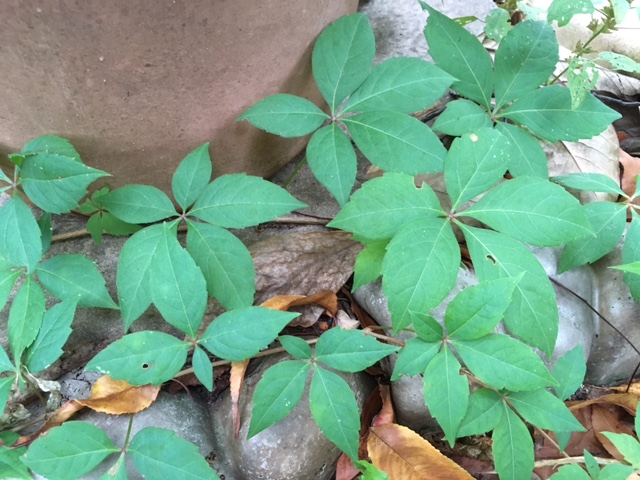
Thanks to Robert for asking about combating English Ivy, an attractive and hardy, but ruinous, vine that many homeowners mistakenly plant or allow to grow.
Affection for English Ivy is understandable—it serves both as a groundcover and a climbing vine, is easily available, and withstands foot and dog traffic. However, as Plant Invaders in the District of Columbia* makes clear, it crowds out important native plants and creates safety hazards as it climbs and suffocates trees and tree branches. Even on a living tree, the weight of English Ivy makes the tree susceptible to branch breaks and blowing over due to wind or winter conditions. It also serves as a reservoir for bacteria that can harm our neighborhood oaks, maples, and other trees and plants. English Ivy spreads by vining and when allowed to grow vertically will produce berries that are spread by fruit-eating birds.
What to do?
Get rid of it. Thankfully, ground ivy is relatively easy to extract. If growing up a tree or other structure, simply cut the vines as close to the ground as possible, making sure to create a gap between the lower and upper vines of at least one inch. The upper ivy will die off over the winter and is easily removed come spring. If you have trees heavily covered by thick ivy vines, consult a professional to avoid tree damage.
Beneficial Replacements.
UDC offers many healthy ivy alternatives, including flowering groundcovers like the eastern prickly pear cactus (Opuntia humifusa)—yes, DC has a native cactus—for sunny spots. For shadier spots “green and gold” (Chrysogonum virginianum) is a great option or a variety of ferns like Christmas fern (Polystichum acrostichoides) for green groundcover through the winter.
I like native Virginia creeper, sometimes known as American Ivy. It is a groundcover and climbing vine that doesn’t cause the same negative impacts as English Ivy and may already be growing in your yard. I’ve seen homeowners pull this beneficial vine out of their English Ivy beds, instead of ripping out English Ivy and letting Virginia creeper stay!
Virginia creeper can remain green through the winter but can also turn a deep red. I have both appearing in my yard depending on sun exposure. Like the English version, the berries are not safe for people to eat but do provide a wonderful source of winter food for birds.
In my yard I just started ripping out “bad” plants like English Ivy and Japanese Honeysuckle to make way for the creeper when it emerged. As it grows, I’ve taken cuttings; stuck them in water; and, when they produce roots, replanted them where I want the cover. Creeper is currently winning the ivy battle! So confront your English Ivy and replace this harmful invasive with beneficial plants. If you have questions, please email me at GloverDigThis@gmail.com * Published by the University of the District of Columbia’s College of Agriculture, Urban Sustainability and Environmental Sciences. Available online.
(originally appeared in the Glover Park Gazette, November 2017)
 StephShain