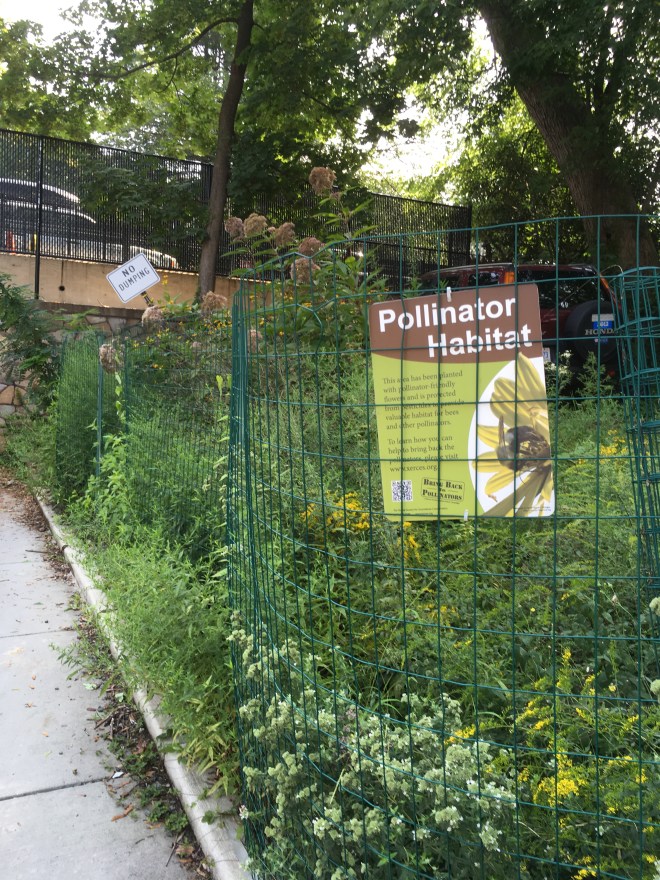
The first time I spied the strip of earth next to our driveway, I couldn’t wait to get my hands in it. Why would someone have filled a space begging for plants with gravel?
About a year later, when I finally decided to plant, I found seemingly impenetrable dirt beneath the few inches of rock. The plants I had purchased were rehomed and I decided to spruce up the space with potted flowers in a row of cinder blocks that had been left behind. Perhaps plants and blocks would be the perfect blend of beauty and roughness
The space was hard to reach with the garden hose. After two years of plants struggling for survival, the empty blocks went off on the neighborhood listserv. For years, hope was abandoned, as was the driveway space. I embraced whatever wild foliage emerged.
Then I read Bringing Nature Home, by Doug Tallamy, and was fascinated to learn of the native plants in our area that are pretty and help critters of all kinds. Unfortunately, all we had burdock and garlic mustard (declared invasive in DC) and a lush blanket of poison ivy.
Embracing Native Plants
Previously, “native plants” bored me. How wrong I was to be uninspired! If anything had a chance of growing in this space, it was a plant meant to be here! I turned to the extensive (and free) resource, Native Plants for Wildlife Habitat and Conservation Landscaping—Chesapeake Bay Watershed produced by the US Fish & Wildlife Service (see PDF on https://www.nps.gov/plants/pubs/ chesapeake/). This information-packed guide goes beyond the usual range of sun/shade plants or what does well in clay or rich soil; it also tells you which plants attract butterflies and hummingbirds, and which invite songbirds or small mammals to your space.
I purchased plants at a number of native plant nurseries and plant sales, and used the guide to be careful about what some places sell as “native.” I also used The Living Landscape: Designing for Beauty and Biodiversity in the Home Garden by Rick Darke and Doug Tallamy for inspiration and because it let me know when plants flower and whether the fruit is edible. My very own “pollinator pathway” was born!
The spring after I planted I could see the strength of natives in full bloom, and in season two it’s full of thriving flowers, completely covering the space, and giving life to so many species of birds, bees, and butterflies.
Some favorites that I planted are Joe Pye Weed, Shrubby St. John’s Wort, various Asters, Mountain Mint, Sneezeweed, Wild Bergamot, Bee Balm, and Gray Goldenrod.
My experiment was imperfect. In hindsight I should have planted fewer varieties, noted timing to better plan my blooms, and tracked sun patterns to keep taller plants from overshadowing smaller ones. But even with these regrets, the space is an incredible source of beauty and life in a space that was previously considered “ungrowable.”
Search online for “Native Plant Sales DC MD VA” and make October the month to launch your own pollinator pathway! Questions? Email me at GloverDigThis@gmail.com.
(this article originally appeared in the Glover Park Gazette, October 2017)
 StephShain